Sunday, May 19, 2013
GIULIO CESARE: Handelian Eye Candy And Anachronism Stews
Why the heck does Ptolemy look like John Wilkes Booth?
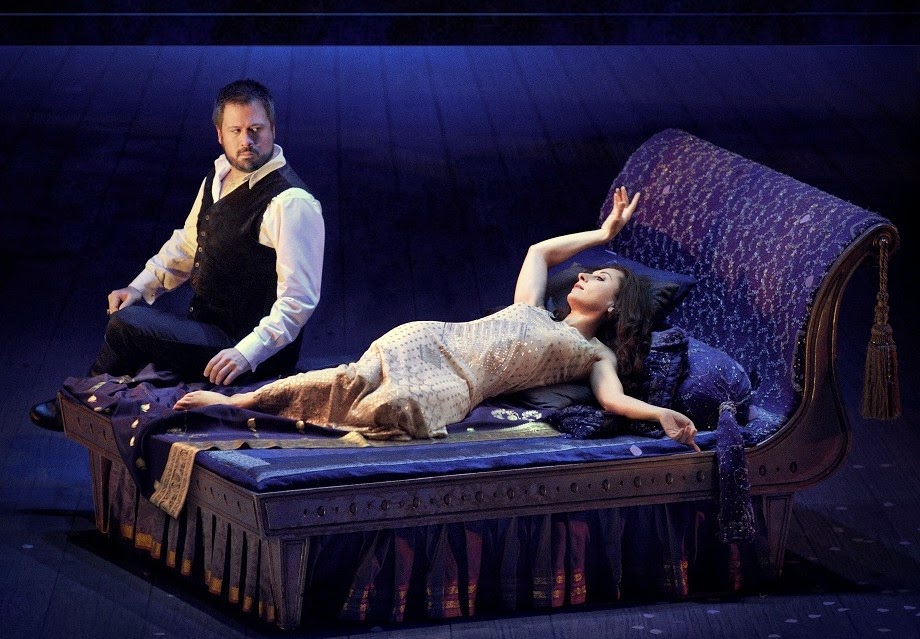
That's only one of the many questions I have for Sir David McVicar, the man who directed the new Met Production of G. F. Handel's Giulio Cesare, which I saw on Wednesday. It was a fun Anachronism Stew of British Imperialism, Asian-ish dancing, and sleazy bad guys who for some reason resemble notorious American traitors. American countertenor David Daniels sang the the title role of Julius Caesar. French soprano Natalie Dessay, who appeared last season in the title role of La Traviata, sang the role of the alluring Cleopatra, the last queen of Egypt. Mezzo-soprano Alice Coote, who I last saw and Hansel in Humperdink's Hansel and Gretal back in '08, sang the trouser role of Pompey's son Sextus. And contralto Patricia Bardon was Pompey's widow Cornelia. On top of all that there was Christophe Dumaux Ptolemy and baritone Guido Loconsolo as Achilla.
The story centers around Caesar and Cleopatra's encounter in 47 B.C., albeit a highly idealized version of the event. Seventeen-year-old Cleopatra seduces and wins the fifty two-year-old Julius Caesar in order to help her overthrow her brother Ptolemy, with whom she is vying for the the throne of Egypt. On top of that, Sextus and his mother Cornelia want revenge for Ptolemy's wanton killing of Pompey after Caesar defeated him.
Act 1 was all about Cleopatra's struggle with her brother Ptolemy for the throne of Egypt and her plan to seduce Caesar over to her side. Sextus and Cornelia plan their revenge on Ptolemy for killing Pompey, all the while Ptolemy is trying to take the throne and his mook Achilla wants Cornelia for himself. Cleopatra disguises herself as a handmaiden and comes to find Caesar and the two almost immediately fall in love. Ptolemy makes both Sextus and Cornelia his prisoners and separates the two, adding Cornelia to his harem.
Act 2 follows Cleopatra's continuing seduction of Caesar (he still doesn't know her identity), and Sextus and Cornelia's continuing plan for revenge. Caesar and Cleopatra are about to make love when news comes to him that his enemies are conspiring against him. Cleopatra reveals her real identity and vows to help Caesar. He says he fears nothing and runs off to battle.
Act 3 sees the downfall of Ptolemy and Cleopatra's ascent to power. Achilla, furious that Ptolemy won't let him have Cornelia, switches allegiance and is killed in battle. Caesar is believed to have died but in fact survived his encounter with the assassins. Cleopatra has been captured after summoning Caesar's army and resolves to take her own life, but is stopped just in time by Caesar's arrival. Sextus kills Ptolemy and Caesar names Cleopatra the sole ruler of Egypt.
David Daniels was stunning (both in talent and in looks) in the role of Julius Caesar. His head seemed to wobble just a bit when he sang, but then again he does that a lot. And Dessay was also great, especially in her first aria of Act 2. The way she entered for the aria was taken right from a story floating around at that time that Cleopatra rolled herself up in a rug and was thus brought to Caesar. It's a good thing she was wearing a flesh-colored tank top underneath her rhinestone bikini top, otherwise her costume would have been listed as NSFB*. What I was expecting but still found surprising was the dancing. They had six dancers, two of them were with Dessay at all times as they were doing double duty as both dancers and handmaidens. Dessay did quite a bit of dancing herself. There were at least three arias that involved her dancing with her two handmaidens.
I hadn't seen Alice Coote since I was sixteen, so I almost didn't recognize her at first. The way she portrayed Pompey's dutiful son was just amazing. And I can't forget Patricia Bardon as Cornelia. She brought out the character of the grieving widow in search of vengeance very well.
If there was one major issue in the opera, it came in Act 3 after Caesar sings his big aria from that act, the men who were lying around dead suddenly come back to life and follow him to victory (except of course or Achilla, who is obviously dead because of his wounds). That made no sense whatsoever. Were these guys pretending to be dead? Were they just drunk? Did they fall asleep after the storm? Why did they lie around looking dead and then just pop back up when Caesar resolves to go into battle? There was also an issue at the very end where everyone is rejoicing in Cleopatra's rise to the throne but they had the already dead characters of Ptolemy and Achilla come back on stage to join the final ensemble (all covered in blood of course). Are they ghosts? Are they somehow undead? Are they figments of Sextus's mind (he seemed to go into one of those "Why Did It Have To Be Done This Way?" moments after killing Ptolemy)? Why did they come back onstage after being dead? It made no sense at all.
There were three other characters that really stood out: Nirenus, Ptolemy, and Achilla. Nirenus was sung by Moroccan countertenor Rachid Ben Abdeslam, who portrayed the character of Cleopatra's spy and confidant as though he were almost a jumpy Victorian cab driver. But he was also was fun loving and took his job seriously (and wore a fez in a few scenes). Actually this was the second time I had heard of an African opera singer (the first one being South African coloratura soprano Pretty Yende in the role of the Countess Adele in Le Comte Ory this season). There aren't very many of those.
Achilla struck me as the stupidest of all the characters. Why? Because as he said as he was dying in Act 3, he counseled Ptolemy to have Pompey killed so that he (Achilla) could marry Cornelia himself. Uh, Achilla, did you even bother to think that killing Cornelia's husband was probably the dumbest way to try to win her hand? She wanted to see her husband alive. Instead you killed him. What were you thinking you stupid idiot?
And finally there's Ptolemy. As I said at the beginning, he looked like John Wilkes Booth. I don't know if Sir David McVicar did that intentionally, but that's who Ptolemy looked like. In fact, I was calling him Booth of Arabia, John in Petticoats, all sorts of Civil War/Booth related nicknames.
It was a good performance all around. Sir David McVicar did a stupendous job creating such a delightful Anachronism Stew of Bollywood, early 20th Century, and 17th style goofiness. Now I would love for him to tell us why Booth--er, Ptolemy looked the way he did, and it would also be good to to hear his explanation on why he brought back the dead in Act 3.
--------------------------------------------------------------------------------------------------------------------------------
* Not Safe For Brain. It means that something is pornographically squicky.
Sunday, May 12, 2013
Saudi Arabian Men Exiled For "Being Too Handsome".
Makes about as much sense as a Renegade Dalek Quidditch team, now doesn't it?
I don't get it either. My sister brought up the fact that a Saudi Arabian guy, or several guys I should say, were banished from the country for being " too sexy". And I thought that was limited to a snobbish queen who thought that her step-daughter was besting her at an unofficial beauty contest. This doesn't make sense.
There has to be some other reason as to why these guys are being deported. Are the religiously fanatical law-enforcement guys really worried that the entire female population will turn into squealing fangirls over these guys? Or is there something else that they don't want to talk about because it will give away what their true motives are?
My best guess is that there's something else going on that the Powers-That-Be in Saudi Arabia don't want to make public.
Friday, May 10, 2013
Mariusz Kwiecien
I first heard this singer in the current Met production of Donizetti's psychological masterpiece Lucia di Lammermoor in '08 (at least I think it was him). I was looking at YouTube videos of the Mad Scene and I was startled to see Enrico looking quite handsome, this Polish baritone was singing the role. In the production I saw in May of '08, Enrico looked like Shaggy Beard in Cathrine Called Birdie. The one from the Met set the story in the Victorian era and made it out to be a ghost story (which makes me think Mary Zimmerman should have renamed it The Curse of the Fountain or something like that).
It has been five years since I first heard Mariusz Kwiecien sing. I actually got to see him live in February of 2010 at Lyric Opera of Chicago when he sang the role of the Count in Le Nozze di Figaro alongside Kyle Ketelsen. I have also heard him as the strutting peacock Belcore in L'Elisir d'Amore. I have also seen him a bunch of times on YouTube in various roles, the one that sticks out to me the most is the title role in Mozart's Don Giovanni. Next season he will sing the title role in Tchaikovsky's Eugene Onegin alongside Anna Netrebko and Piotr Beczala.
I have seen his website. This is one amazing barihunk. While I don't particularly like people talking about seeing him with his shirt off, I still think he's hot. And I still say that if you haven't heard of or seen him, fix that. Now. And I still say his voice can kill an opponent in mortal combat.
Saturday, April 27, 2013
DON GIOVANNI
Don Giovanni, the Mozart masterpiece was performed by Madison Opera last night at the Overture Center. This one is a story of seduction, murder, revenge, and damnation. Making his Madison Opera debut was baritone Kelly Markgraf in the title role (don't ask me why a male has the name "Kelly").
The opera is based off of Moliere's play Don Juan, which is about a lascivious Spanish nobleman who goes around seducing women let and right. When the curtain rises he's busy with a beauty while his servant Leporello serves as sentry. Leporello resents having to serve the Don as he doesn't eat or sleep well. Then we meet Don Giovanni and his attempted latest conquest, Donna Anna. Giovanni had snuck into her bedroom and tried to rape her. She calls for help and her father, a Commendatore, comes to challenge Giovanni. While Anna runs to find help, the Commendatore fights Giovanni and is fatally wounded. Giovanni and Leporello leave as Anna and her fiance, Don Ottavio, discover the dead man's body. Anna and Ottavio both swear revenge.
But Giovanni goes off looking for another conquest. He overhears a woman crying, lamenting after being abandoned by her lover. When Giovanni goes to console her ("The same way he's consoled about 1,800 other women," Leporello remarks), he discovers it is none other than Donna Elvira, a previous conquest. Giovanni escapes while Leporello tells Elvira that she is not the first woman Giovanni has seduced, nor is she the last. He then proceeds to read the list of Giovanni's conquests to her: 640 in Italy, 231 in Germany, 100 in France, 91 in Turkey, and in Spain 1,300. That's 2,065 women all told*!
Zerlina and Masetto, a peasant couple, are celebrating their wedding when Giovanni comes in and sends Masetto away. He then attempts to seduce Zerlina, but is foiled when Elvira comes in and tells the girl to flee from Giovanni. Anna and Ottavio come in asking Giovanni for help not realizing that he is man who ravished Anna and murdered her father. They only find out when Giovanni leaves that he is the man they're looking for. Ottavio is worried about Anna's state of mind. Meanwhile, Zerlina assures a jealous Masetto that she is faithful.
Giovanni has invited the entire wedding party to his house in hopes of getting Zerlina into bed. In fact, all he can think about is drinking and having sex with as many country wenches as he can get his hands on. Anna, Ottavio, and Elvira don masks and are invited in by Leporello. Giovanni tells Leporello to distract Masetto while he dances with Zerlina and drags her into an adjacent room in order to rape her. She cries out for help and Giovanni tries to lay the blame on Leporello. But Anna, Ottavio, and Elvira demask, and all Giovanni can do is escape quietly.
As the second act opens, Leporello wants to leave Giovanni but is easily won back with money. Giovanni plans to seduce Elvira's maid. But Elvira herself is present, so Giovanni and Leporello switch cloaks in order to fool her so that Giovanni can get on with his conquest. Once again, Elvira falls for the Don's seductive voice. Once she and the disguised Leporello leave, Giovanni begins his conquest. But once again he is interrupted as Masetto and several companions come in looking for him. But don't recognize him because of his disguise. Giovanni disarms Masetto and disperses his companions, then proceeds to beat up the young man. After Giovanni slips away, Zerlina comes by and comforts Masetto, placing his hand on her bosom and telling him where he'll find healing.
Meanwhile, Leporello is still with with Elvira , but he can't keep up masquerading as Giovanni for much longer, and is trying to find some means of escape before Elvira discovers the ruse. Before he an escape, however, he is caught by Anna, Ottavio, Zerlina, and Masetto who think he's Giovanni. Elvira protests saying that he;s her husband but the others will have none of it. Everyone is stunned when Leporello reveals his identity. Ottavio is now certain that Giovanni is the man who attacked Anna and murdered her father, and thus becomes even more determined to take revenge. Elvira, meanwhile, can only think if Giovanni. Although he has betrayed her, she still loves him, and she foresees his doom.
Giovanni meets up with Leporello outside a cemetery with with several equestrian statues; one of them being that of Anna's late father, the Commendatore. Giovanni laugh at Leporello's annoyance. But then the disembodied voice of the Commendatore is heard telling Giovanni that his laughter shall be silenced by dawn. But Giovanni thinks nothing of it and makes Leporello invite the statue to dinner, which it agrees to.
Ottavio is trying to understand why Anna still refuses to marry him and thinks she is being cruel. Anna assures him that she does in fact love him; she just doesn't think she can marry so soon after her fathers death (not to mention that her father's killer is still at large).
Giovanni is eating his meal with gusto as a famished Leporello watches jealously. Elvira rushes in telling Giovanni that she forgives him and feels only pity for him. But he laughs her off when she ask that he change his ways and she leaves distraught. Suddenly she screams and runs off through a different door. Leporello goes to see what frightened her and lets out a scream to match hers. Giovanni asks what is going on and Leporello tells him the statue has arrived. The Commendatore then enters and tells Giovanni to repent. When Giovanni refuses, the statue drags him down to Hell alive.
Anna, Ottavio, Elivra, Zerlina, and Masetto all enter hoping to find Giovanni. Instead they find Leporello, huddled in a corner all shaken up at what he's just seen. He tells what happened and the others cannot believe it. Anna and Ottavio agree to wait a year before getting married so that Anna can get over her father's death. Elvira, feeling that she has nowhere else to go, decides to take the veil and enter a convent. Zerlina and Masetto decide to finally go home and have dinner. And Leporello, now out of work, is going job hunting. Everyone reflects on the moral of the story: "Thus shall pass all who do evil. The death of a sinner reflects his life."
This was the first production of Don Giovanni I saw live onstage. The sets for the production were mostly tall walls with doorways that were moved periodically throughout the opera, even by the characters themselves (since when did opera characters lean on the fourth wall like that?). In the background was a painted screen showing a rose. This rise changes color often throughout the performance depending on the time of day and the mood. For example, in the scene where Giovanni and Zerlina have their famous duet, the rose turns passionate red. In a nighttime scene, it turns either blue or grey. After the dramatic overture, we meet Leporello outside Donna Anna's house. He is sitting off to the left looking through the same old book of the Don's conquests. He is not pleased about being the servant of such a man; he doesn't eat or sleep well. The story has Don Giovanni wearing mask when he first enters. In this production, not only was he not wearing a mask, but he was also shirtless. I suppose they needed an establishing character moment for him, but it still seems excessive. He jumped off of the balcony followed by Anna, who was clad in her nightgown and wielding a knife to fend off her attacker. The Commendatore came out and challenged Giovanni while Anna ran for help. While she was gone, Giovanni murdered the Commendatore and fled. Anna returns with Don Ottavio and collapses when she sees her father dead. After she comes round, they both swear vengeance on the murderer.
In this production, when Giovanni and Leporello hide in order to observe Donna Elvira (whom they don't recognize yet), they actually move part of the set. Elvira entered carrying trunks and was accompanied by two well-dressed footman helping her find her way. She has been looking all over the place for Giovanni and is determined to either have him back or else kill him. She actually looked like she was asking some passers-by if they knew where her missing lover was. She is both furious and grief-stricken. And Giovanni is caught completely of guard when discovers her identity. He gets Leporello cover his escape and with that, Leporello proceeded to read off the list of conquests. this production left out Elvira's recitative where she swears revenge on the man who betrayed her.
Zerlina and Masetto entered followed by wedding guests carrying chairs and throwing flowers about. Zerlina was clad in a yellow dress with a veil pinned in her hair. Giovanni entered and not only shooed Masetto away, but invited the party to his place. Masetto is a peasant, Giovanni is a nobleman. So there's no way Masetto can protest. After everyone leaves, Giovanni woos the bride in the famous La ci darem la mano duet. But the encounter is interrupted by Elvira, who tells the young girl to flee. I noticed that the rose in the background turned green when Elvira came in. She's reeling with jealously at the fact that Giovanni is seducing another woman. Anna and Ottavio enter. This time Anna is clad in a black dress and she is mourning her father's death. They find Giovanni, but don't recognize him as the man who murder the Commendatore. Elvira tells them not to believe Giovanni, and it's only after he leaves that Anna recognizes him by his voice. Unfortunately, they left out Dalla sua pace in which Ottavio worries about Anna's condition. He's torn and upset because she's torn and upset. Actually, Giovanni once saved Ottavio's life. So he considers Giovanni to be a savior. And finding out that his friend seduced his beloved and murder her father is really hard on him.
Giovanni is looking forward to a night of orgiastic pleasure and some more trophies to put in his book. This scene had wedding guest coming in drunk and passing out on the cushions and chairs. Meanwhile, Masetto is jealous and upset with Zerlina for flirting with Giovanni. Zerlina protests and assures him that she is faithful. But she is startled and terrified when she hears the Don's voice coming form another room. She and Masetto hide as Giovanni enters. In this production, they pretended to be passed out like the others in the room. Zerlina even tries to hide behind a cushion fort. Giovanni isn't fooled and temporarily gives her back to Masetto. Meanwhile, Anna, Ottavio, and Elvira have donned masks and are invited in by Leporello. he thinks they're just maskers. Ottavio looked like he was trying to keep Anna from giving them away to early. The scene had chairs on the left, a couch on the right, a feast in the upper left corner, and a bed that was wheeled in and out of the room, with rose petals falling all over the place. At one point, Giovanni was sitting on the bed with four women clinging about him. When the music starts again, Giovanni has Leporello distract Masetto so that he can dance with Zerlina and get her into bed. This production showed Masetto not dancing with Leporello, but instead having the latter get him to submit to a bunch of girls. This production had Giovanni place Zerlina on the bed and wheel her out of the room. When she cried for help, she was wheeled back in; her hands tied to the bedposts and Giovanni wanted to keep her still while he attempted to rape her. Giovanni tries to lay the blame on Leporello, but Anna, Ottavio, and Elvira are not fooled, and foil Giovanni's plans by demasking and chasing him out. I saw one lone rose petal fall and land a bull-eye on one of the cushions. I thought it added to the atmosphere of disappointment and rage at the fact that the party just got ruined.
Act 2 had the balcony from Act 1 on the left side. After bribing Leporello back into service with cash, Giovanni and Leporello switched cloaks as Elvira comes onstage again. She is clad in her shift in this scene. She is still feeling betrayed, but falls once again for the Don's seductive voice. Leporello impersonated Giovanni so that the latter could seduce Elvira's maid (his rich clothes would arouse suspicions a little too easily). They leave while he sings a remarkable serenade. He saw Masetto and several others coming looking for him, but they don't recognize him in his disguise. Giovanni disarmed Masetto, scatters his companions, and beats him up. Zerlina arrived holding a lantern and wearing a shawl over her dress. She started kissing him and telling him where he'll find healing.
Elvira still thought that Leporello was the Don and Leporello knew he wouldn't be able to keep up the facade for very long. This production had him lean on the fourth wall again by backing away slowly while pushing a set piece. But before he could escape, Anna, Ottavio, Zerlina, and Masetto caught him off guard. Elvira protested, but Leporello got away after revealing who he was. This Ottavio aria was included. Il mio tesoro is where he strengthened his resolve to avenge the death of the Commendatore. In contrast, Elvira lamented Don Giovanni's fate. He betrayed her, but she still loves him, and in her mind she sees the abyss opening before him and a deadly thunderbolt above his head.
Giovanni laughed at the various turn of events and Leporello was not happy that he nearly got killed. This production featured a gate that led to the graveyard and behind was an equestrian statue atop a large pedestal with the inscription on the side. I couldn't see the upper half but hearing the disembodied voice was scary enough. Giovanni talked the reluctant and terrified Leporello into inviting the statue to dinner, which it accepted.
Ottavio thought Anna was cruel in that she didn't want to marry him. She pointed out that she indeed loves him, she just couldn't marry him right then.
The feast scene had a full able in the lower right corner plus a few chairs. Giovanni was eating like a pig, Leporello can only sneak small bite. They are listening to the greatest hits of the day, including Mozart's original Non piu andrai from Le Nozze di Figaro ("Now that tune I know too well," Leporello deadpans). Elvira tried to get Giovnni to change, but he refused. In the background was the statue and silver petals were falling this time. When Elvira saw the statue, she screamed and ran like a scared rabbit. Leporello screamed too and then the statue began to knock. This production had the monument part and out stepped the ghost of Anna's father, the Commendatore, surrounded by fog (did they use liquid nitrogen?) and we hear the strains from the first part of the overture. This one had the ghost sit down with Giovanni during their exchange. The ghost moved slowly and stiffly, as if they were trying to emphasize the Uncanny Valley aspect of the ghost. The ghost asks if Giovanni will dine with him; Giovanni accepts. He takes off his shirts and takes the ghost's hand which is cold as ice. The ghost tells him to repent, Giovanni will not. The Commendatore then pulls Giovanni into the monument with hellfire coming up from beneath.
Everyone else ran in to find out what happened. Leporello was crouched behind the table looking totally shaken up, and he told them what happened. During the moralizing coda, he took a cake from the table and just before the music ended, he took a huge bite from it. I think that goes to show that he has not eaten well for months.
A few performance comments: I thought that Kelly Markgraf looked like Kyle Ketelsen from the distance we were at. it may have been because of the wig he was wearing. This was also the first time I saw soprano Elizabeth Caballero. I had heard her in rebroadcasts of Carmen and la Traviata, but I saw her for the first time in this performance. The soprano singing Elvira had to be the one I saw in the simulcast of Zandonai's Francesca da Rimini, in the role of Biancafiore. And I can't believe the guy who sang Masetto also sang Count Horn in Un Ballo in Macasara back in November.
Also, I had always wondered how old Giovanni must be. If he started his philandering at age fifteen, it is definitely possible that he could be twenty-five. Then again it could also be, as baritone Simon Keenlyside puts it, that the good days are over and he's not what he used to be. However old he is, he's good-looking enough that he can charm woman.
Good performance, good singers, and they shoulld really do this one again.
----------------------------------------------------------------------------------------------------------------------------------
*I did the math. It sounds impossible, but Don Giovanni is rich enough and travels enough that it is indeed possible that he would have been able to get a woman into bed virtually every night.
Wednesday, April 24, 2013
ANFSTD
A priest doing a baptism for an infant says to the parents, "Name this child." "Pindonim," the mother says. "That's a weird name," says the priest. "No," says the mother. "We want 'Albert'. It's 'pindonim' with a safety pin."
Monday, April 22, 2013
Rectification Of Names
I have heard such words as "homophobic", "un-American", "commitment-phobic", etc.. What I don't like about them is that they really don't mean anything.
The Chinese philosopher Confucius believed that social disorder can come from not understanding what someone is saying. It is therefore imperative that people call things by their proper name (hence "rectification of names"). That includes using words that actually mean something. Here is a quote from Confucius on the subject:
"A superior man, in regard to what he does not know, shows caustic reserve. If the names be not correct, the language is not in accordance with the truth of things. If the language be not in accordance with the truth of things, affairs cannot be carried out to success. If affairs are not carried out to success, proprieties and music do not flourish. When proprieties and music do not flourish, punishments will not be properly awarded. When punishments are not properly awarded, the people do not know how to move a hand or foot. Therefore the superior man considers it necessary that the names he uses may be spoken appropriately, and also what he speaks may be carried out appropriately. What the superior man requires is that in his words there may be nothing incorrect."
Let's take a look at the words I listed above:
"Homophobic" is said to mean "someone who hates homosexuals". Roughly translated from Greek it means---what? Same fear? After all homos means "same" and phobos means "fear". You can see what confusion results from this. "Homophobic", believe it or not, in the end does not really mean anything in particular. It is simply used as an abusive insult to people who disagree with the homosexual lifestyle. So they're just being rude to people who don't agree with them. This does not encourage good relationships with people.
"Commitment-phobic" is often used to describe men. It may sound like it means something, but it really doesn't. If you want to describe a man who does not want to commit and instead go around seducing women left and right, "commitment-phobic" is not the word to use. "Dissolute", "philanderer", or "lascivious" would better describe someone like that. The other problem is that people use the word to describe men generally. This is wrong. While there are indeed men who philander about and seduce women, to say all men are "commitment-phobic" is not really specific. And hence you get a lot of confusion, plus a highly unfortunate stereotype of an overly-sexualized male.
"Un-American" is meant to sound like something is not American. This also doesn't mean a thing simply because---it doesn't. It just isn't really word for anything. It is also a term of abuse. If you say something is "un-American", you're just being insulting. And insults do not make good arguments. If anything, it just turns people off to your argument.
When people talk about Rectification of Names, they are talking about being clear and specific about what you are saying. When people throw meaningless words, they sow confusion and destruction. So when Confucius talked about calling things by their proper name, he was saying that using words correctly encourages order. What that means is that people should throw away words like "homophobic" and stuff like that, and just try to actually use words that mean something. Just throwing around insults does not help anything or anyone.
The Chinese philosopher Confucius believed that social disorder can come from not understanding what someone is saying. It is therefore imperative that people call things by their proper name (hence "rectification of names"). That includes using words that actually mean something. Here is a quote from Confucius on the subject:
"A superior man, in regard to what he does not know, shows caustic reserve. If the names be not correct, the language is not in accordance with the truth of things. If the language be not in accordance with the truth of things, affairs cannot be carried out to success. If affairs are not carried out to success, proprieties and music do not flourish. When proprieties and music do not flourish, punishments will not be properly awarded. When punishments are not properly awarded, the people do not know how to move a hand or foot. Therefore the superior man considers it necessary that the names he uses may be spoken appropriately, and also what he speaks may be carried out appropriately. What the superior man requires is that in his words there may be nothing incorrect."
So you see just how things can be affected by using the right or wrong word. Using the example of the old "Want of a Nail" poem, if just one thing is missing or wrong, everything can fall apart. So using word properly is important.
Let's take a look at the words I listed above:
"Homophobic" is said to mean "someone who hates homosexuals". Roughly translated from Greek it means---what? Same fear? After all homos means "same" and phobos means "fear". You can see what confusion results from this. "Homophobic", believe it or not, in the end does not really mean anything in particular. It is simply used as an abusive insult to people who disagree with the homosexual lifestyle. So they're just being rude to people who don't agree with them. This does not encourage good relationships with people.
"Commitment-phobic" is often used to describe men. It may sound like it means something, but it really doesn't. If you want to describe a man who does not want to commit and instead go around seducing women left and right, "commitment-phobic" is not the word to use. "Dissolute", "philanderer", or "lascivious" would better describe someone like that. The other problem is that people use the word to describe men generally. This is wrong. While there are indeed men who philander about and seduce women, to say all men are "commitment-phobic" is not really specific. And hence you get a lot of confusion, plus a highly unfortunate stereotype of an overly-sexualized male.
"Un-American" is meant to sound like something is not American. This also doesn't mean a thing simply because---it doesn't. It just isn't really word for anything. It is also a term of abuse. If you say something is "un-American", you're just being insulting. And insults do not make good arguments. If anything, it just turns people off to your argument.
When people talk about Rectification of Names, they are talking about being clear and specific about what you are saying. When people throw meaningless words, they sow confusion and destruction. So when Confucius talked about calling things by their proper name, he was saying that using words correctly encourages order. What that means is that people should throw away words like "homophobic" and stuff like that, and just try to actually use words that mean something. Just throwing around insults does not help anything or anyone.
Friday, April 19, 2013
Boston Suspect
Monday saw the Boston Marathon ruined by a series of several bombs going off just as racers reached the finish line. What kind of sick, twisted moron would do this sort of thing? Two Chechen guys from the sound of it. One suspect is dead, the other has been captured.
Chechnya has been a breeding ground for terrorists for quite some time now, and they are quite creative with their methods. In fact, the Boston bombing is being treated as a terrorism case, as it seems only a terrorist would dream something like this in the first place. Some time after the bombs went off, two young men were caught on surveillance camera and the police believe they were the ones responsible.
I wonder what exactly made these two men the prime suspects. Well, there were hundreds of people in attendance, and in this day and age of the readily available video cameras on cell phones, there were people taking pictures and videos of the race. Those cameras were going when the bombs went off. There were also several people who were not watching the race. Now granted some may have been taking to their friends or family or whoever, but only two seemed to be of note. Not only that, but the suspects were carrying enormous black backpacks. I'm not talking the average everyday schoolbag, I'm talking ones that are big enough to carry a pressure cooker without a lid. No other person was seen with that kind of backpack.
The men's father is in denial and their uncle is furious. The father is so sure that his sons have been set up by the Secret Service, whereas the uncle was saying earlier that the men had brought shame to the family and the Chechen people.
My only hope now is that the captured suspect doesn't kill himself before we have the whole story.
Subscribe to:
Posts (Atom)


