This festival in Token Creek Park is smaller than Greekfest in Madison, but is fun nonetheless. There is not to say about this except that it is held one a year in June and is based around the old Russian summer celebration.
My younger brother and I went to this small fair yesterday. I made a wreath at a small work table where they were doing that, and I lived dangerously and tried some traditional Russian food potato pies. This was the first time I actually heard people conversing in Russian. And what was the best part was simply getting to know some Russian people.
If you want to go next year, do so. It's more for getting to know people and enjoying their company.
Sunday, June 23, 2013

Wednesday, June 19, 2013
Nopony Messes With Our Derpy!
I know this happened last year, but I'm still really ticked at how people handled the appearance of the popular background pony known as Derpy Hooves when she appeared in the My Little Pony: Friendship is Magic season two episode, The Last Roundup. Hasbro altered her voice in later installations because they thought it was offensive. I don't care that people thought that her clumsiness and Rainbow Dash's frustration with her was offensive to so-called "mentally challenged" people. A someone with a learning disability, I can relate to Derpy. I have had people get frustrated with me due to quirks related to my AS. So I understand Derpy, and no, she's not used as the butt of stupid jokes. So why should people get their knickers in a twist over what they saw initially when The Last Roundup first premiered? She's our Derpy, so don't you muck with her like that!
-------------------------------------------------------------------------------------------------------------------------------
In regards to altering Derpy's voice, I don't anyone could have said it better than Rainbow Dash and Rarity.

-------------------------------------------------------------------------------------------------------------------------------
In regards to altering Derpy's voice, I don't anyone could have said it better than Rainbow Dash and Rarity.
Sunday, June 16, 2013
Robin Shou
I have become a serious fan of the two Mortal Kombat films from the Nineties (yes I know people don't like the second one, but please don't act like I'm an idiot for liking it). This was the first time I heard of this Hong Kong martial artist by the name of Robin Shou. He's a great actor and amazing Wushu martial artist. I just don't know why he doesn't he appear more often. I don't care that the Mortal Kombat films weren't all that great; Shou is still a superb actor. I would love to see more of him, and in major roles at that. And it would also be so cool if this guy could do something here in the Madison area.
I have seen his website. And I would like to see him play against type and do such roles as Cyrano, Macduff, or even Oberon. Now that would be something. Oh, and how the hey did he pull off Liu Kang's trademark Bicycle Kick in the first Mortal Kombat film?
I have seen his website. And I would like to see him play against type and do such roles as Cyrano, Macduff, or even Oberon. Now that would be something. Oh, and how the hey did he pull off Liu Kang's trademark Bicycle Kick in the first Mortal Kombat film?
Saturday, June 8, 2013
MADAME BOVARY: What Happens When The Ideal And The Real Collide
WARNING: THIS POST CONTAINS SPOILERS! IF YOU DO NOT WISH TO KNOW THE ENDING YET, DO NOT PROCEED FURTHER!
Madame Bovary is Gustave Flaubert's famous novel about a young woman who believes that life is like a romance novel and lands herself in so much trouble because of it. When the novel first cam out, Flaubert was put on trial for offending public morality. I guess it became a classic simply because of the juxtaposition of the heroine's romantic expectations and the reality of how the things actually work out. And she pays quite a hefty price in the end--literally.
The story takes place in Normandy in Northern France. Emma is the daughter of a well-off farmer who spend her time reading romantic novels. She is courted by and then marries Charles Bovary, a kindly-but-stupid country doctor based in what is now known as Tôtes. Considering married provincial life dull, boring, and beyond lame, Emma soon grows tired of her husband's company. After they attend a ball hosted by a Marquis, Emma's yearning for the romantic and luxurious life really begins to take off. She starts becoming morose and irritable, leading Charles to believe she needs a change of scenery. They move to the town of Yonville, which Emma also finds dull. Some time later she gives birth to a daughter, Berthe, and decides that motherhood is also boring.
Emma later meets a young student named Léon, who shares her love for "the finer things in life". They start courting in secret until Léon has to leave for Paris to go into legal studies. Then Rodolphe, a rakish landowner lays his eyes on Emma and decides to woo her himself, and Emma throws herself into the affair, body and soul. Meanwhile she starts buying a lot of expensive clothes, jewelry, and whatnot on credit.
After four years of illicit love, Emma asks Rodolphe to elope with her. But Rodolphe is worries about Emma's increasing recklessness and willingness to compromise herself. He writes her a self-excusing letter, ending their relationship. Emma is devastated and falls gravely ill and turns briefly to religion. When she is nearly recovered, Charles takes her to the opera where she again encounters Léon. The two start their affair in earnest this time, with Emma lying to her husband regarding her whereabouts. The affair is passionate, but Léon soon becomes bored with the matter and Emma becomes ambivalent about him. Meanwhile, Emma continues to be a spendthrift.
When the time comes to collect the payment, Emma has racked up 8,000 francs worth of debt. Panicked at the news, she tries asking for money from various people, including Rodolphe and Léon, only to be turned down. In despair, she swallows arsenic hoping it would a quick death; even the romance of suicide fails her and she dies in appalling agony. Poor Charles, being as stupid as he was, never even suspected that Emma was unfaithful to him until some time after she's dead when he finds her letters to Rodolphe and Léon. He becomes reclusive and dies, leaving little Berthe in the care of elderly relatives, and eventually being sent to work in a cotton mill.
The main theme focuses on Emma's selfishness and refusal to accept reality. She stopped maturing mentally and emotionally as a teenager at the convent. She has not cultivated discernment, so she doesn't even bother to think about whether Charles is a good match or not before she gets married. She has inbibed so much from the novels she reads that she doesn't think to see life any other way. In fact, she would rather live in a book than in the real world. The problem is simply that fact that it's impossible to live in a book where everything is all written out and people get what they want or have coming. And Emma refuses to see this.
She longs for the illusion, the emotion, the luxurious. To her, happiness and love come in a bejeweled case lined with silk. An ideal location is a luxurious boudoir on a soft feather bed with satin sheets, or a moonlit balcony on a summer night. An ideal mate is an aristocrat with money practically growing in his backyard. None of these ideas match her provincial surroundings, nor does it resemble anything she would likely have. And Emma refuses to accept this.
Emma's desire for the rich and romantic is further fueled when she and Charles attend the Marquis's ball. She sees all the splendor that she dreams of; the music, the clothes, the jewels, handsome rich men, everything she wants is there. But it is unavailable to her, and she stills tries to attain it. She does it by taking advantage of Charles's low IQ and lack of jealousy by lying to him. She spends his money like a proud baroness, and tries to postpone her debts, only to find that her spendthrift ways have put her and those around her in jeopardy.
Her two adulterous affairs revolve around her trying to find the romantic ideal man she yearns for. She first tries and affair with Léon, a young student. He to likes romantic tales of love and passion just as much she does. But he soon has to leave. Emma then falls in love the wealthy Rodolphe, who seems to have everything she longs for. Their love lasts for four years. But he's not as into her as she is into him. Rodolphe sees her as just another in a long line of mistresses; Emma sees him as the perfect ideal lover she has always dreamed of. Although he is a Casanova, Rodolphe knows that Emma is married and has a little daughter. He ends the relationship because he is afraid he will ruin her. This devastates Emma who wants to get out of her reality and escape into fantasy. There is also the fact that Emma thinks she's found a duke, count, or some other nobleman. Rodolph is a country landowner, not that high up the social ladder.
Emma's romantic ideas are repeatedly smashed throughout the story, and her refusal to be content with what she's got culminate in her committing suicide. Hoping to die a romantic death, she swallows arsenic and expects the end to take come quickly. Unfortunately, arsenic does not kill that quickly, and Emma suffers from horrible illness before finally succumbing. In short, all the romantic ideas that Emma had fail her even in death.
Madame Bovary is a must-read not only because of such a well-constructed ideal-collides-with-the-real storyline, but also because of Gustave Flaubert's style of writing. His is a prime example of purple prose done right. Why do I say that? Because Flaubert knew how to make it work. He understood how to use it to convey emotion or describe a scene. Most importantly, he knew when to use it. And knowing when to use purple prose is very important when writing a good dramatic story.
Get this book at your library, or buy your own copy. Either way, you'll enjoy it.
Madame Bovary is Gustave Flaubert's famous novel about a young woman who believes that life is like a romance novel and lands herself in so much trouble because of it. When the novel first cam out, Flaubert was put on trial for offending public morality. I guess it became a classic simply because of the juxtaposition of the heroine's romantic expectations and the reality of how the things actually work out. And she pays quite a hefty price in the end--literally.
The story takes place in Normandy in Northern France. Emma is the daughter of a well-off farmer who spend her time reading romantic novels. She is courted by and then marries Charles Bovary, a kindly-but-stupid country doctor based in what is now known as Tôtes. Considering married provincial life dull, boring, and beyond lame, Emma soon grows tired of her husband's company. After they attend a ball hosted by a Marquis, Emma's yearning for the romantic and luxurious life really begins to take off. She starts becoming morose and irritable, leading Charles to believe she needs a change of scenery. They move to the town of Yonville, which Emma also finds dull. Some time later she gives birth to a daughter, Berthe, and decides that motherhood is also boring.
Emma later meets a young student named Léon, who shares her love for "the finer things in life". They start courting in secret until Léon has to leave for Paris to go into legal studies. Then Rodolphe, a rakish landowner lays his eyes on Emma and decides to woo her himself, and Emma throws herself into the affair, body and soul. Meanwhile she starts buying a lot of expensive clothes, jewelry, and whatnot on credit.
After four years of illicit love, Emma asks Rodolphe to elope with her. But Rodolphe is worries about Emma's increasing recklessness and willingness to compromise herself. He writes her a self-excusing letter, ending their relationship. Emma is devastated and falls gravely ill and turns briefly to religion. When she is nearly recovered, Charles takes her to the opera where she again encounters Léon. The two start their affair in earnest this time, with Emma lying to her husband regarding her whereabouts. The affair is passionate, but Léon soon becomes bored with the matter and Emma becomes ambivalent about him. Meanwhile, Emma continues to be a spendthrift.
When the time comes to collect the payment, Emma has racked up 8,000 francs worth of debt. Panicked at the news, she tries asking for money from various people, including Rodolphe and Léon, only to be turned down. In despair, she swallows arsenic hoping it would a quick death; even the romance of suicide fails her and she dies in appalling agony. Poor Charles, being as stupid as he was, never even suspected that Emma was unfaithful to him until some time after she's dead when he finds her letters to Rodolphe and Léon. He becomes reclusive and dies, leaving little Berthe in the care of elderly relatives, and eventually being sent to work in a cotton mill.
The main theme focuses on Emma's selfishness and refusal to accept reality. She stopped maturing mentally and emotionally as a teenager at the convent. She has not cultivated discernment, so she doesn't even bother to think about whether Charles is a good match or not before she gets married. She has inbibed so much from the novels she reads that she doesn't think to see life any other way. In fact, she would rather live in a book than in the real world. The problem is simply that fact that it's impossible to live in a book where everything is all written out and people get what they want or have coming. And Emma refuses to see this.
She longs for the illusion, the emotion, the luxurious. To her, happiness and love come in a bejeweled case lined with silk. An ideal location is a luxurious boudoir on a soft feather bed with satin sheets, or a moonlit balcony on a summer night. An ideal mate is an aristocrat with money practically growing in his backyard. None of these ideas match her provincial surroundings, nor does it resemble anything she would likely have. And Emma refuses to accept this.
Emma's desire for the rich and romantic is further fueled when she and Charles attend the Marquis's ball. She sees all the splendor that she dreams of; the music, the clothes, the jewels, handsome rich men, everything she wants is there. But it is unavailable to her, and she stills tries to attain it. She does it by taking advantage of Charles's low IQ and lack of jealousy by lying to him. She spends his money like a proud baroness, and tries to postpone her debts, only to find that her spendthrift ways have put her and those around her in jeopardy.
Her two adulterous affairs revolve around her trying to find the romantic ideal man she yearns for. She first tries and affair with Léon, a young student. He to likes romantic tales of love and passion just as much she does. But he soon has to leave. Emma then falls in love the wealthy Rodolphe, who seems to have everything she longs for. Their love lasts for four years. But he's not as into her as she is into him. Rodolphe sees her as just another in a long line of mistresses; Emma sees him as the perfect ideal lover she has always dreamed of. Although he is a Casanova, Rodolphe knows that Emma is married and has a little daughter. He ends the relationship because he is afraid he will ruin her. This devastates Emma who wants to get out of her reality and escape into fantasy. There is also the fact that Emma thinks she's found a duke, count, or some other nobleman. Rodolph is a country landowner, not that high up the social ladder.
Emma's romantic ideas are repeatedly smashed throughout the story, and her refusal to be content with what she's got culminate in her committing suicide. Hoping to die a romantic death, she swallows arsenic and expects the end to take come quickly. Unfortunately, arsenic does not kill that quickly, and Emma suffers from horrible illness before finally succumbing. In short, all the romantic ideas that Emma had fail her even in death.
Madame Bovary is a must-read not only because of such a well-constructed ideal-collides-with-the-real storyline, but also because of Gustave Flaubert's style of writing. His is a prime example of purple prose done right. Why do I say that? Because Flaubert knew how to make it work. He understood how to use it to convey emotion or describe a scene. Most importantly, he knew when to use it. And knowing when to use purple prose is very important when writing a good dramatic story.
Get this book at your library, or buy your own copy. Either way, you'll enjoy it.
Sunday, May 19, 2013
GIULIO CESARE: Handelian Eye Candy And Anachronism Stews
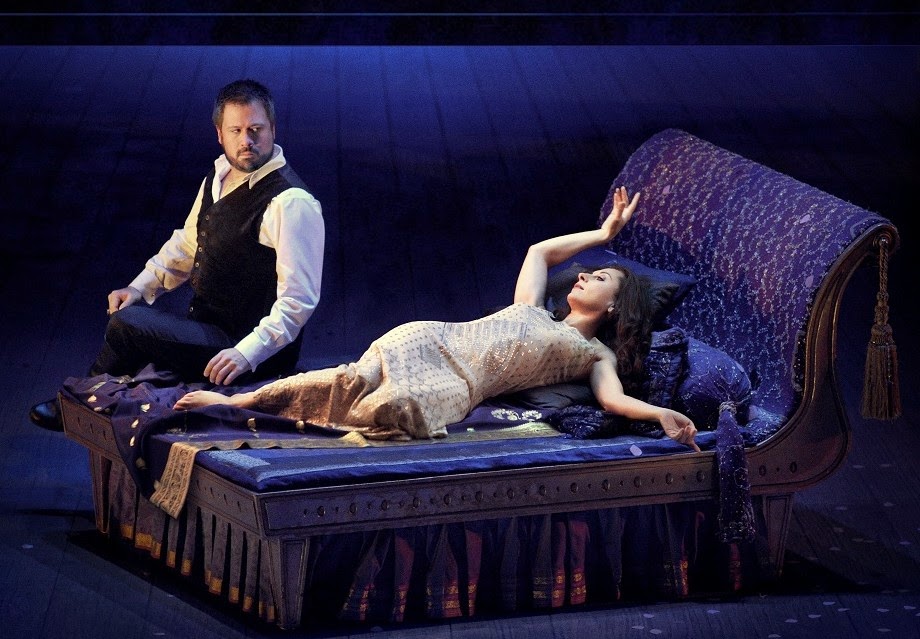
Why the heck does Ptolemy look like John Wilkes Booth?
That's only one of the many questions I have for Sir David McVicar, the man who directed the new Met Production of G. F. Handel's Giulio Cesare, which I saw on Wednesday. It was a fun Anachronism Stew of British Imperialism, Asian-ish dancing, and sleazy bad guys who for some reason resemble notorious American traitors. American countertenor David Daniels sang the the title role of Julius Caesar. French soprano Natalie Dessay, who appeared last season in the title role of La Traviata, sang the role of the alluring Cleopatra, the last queen of Egypt. Mezzo-soprano Alice Coote, who I last saw and Hansel in Humperdink's Hansel and Gretal back in '08, sang the trouser role of Pompey's son Sextus. And contralto Patricia Bardon was Pompey's widow Cornelia. On top of all that there was Christophe Dumaux Ptolemy and baritone Guido Loconsolo as Achilla.
The story centers around Caesar and Cleopatra's encounter in 47 B.C., albeit a highly idealized version of the event. Seventeen-year-old Cleopatra seduces and wins the fifty two-year-old Julius Caesar in order to help her overthrow her brother Ptolemy, with whom she is vying for the the throne of Egypt. On top of that, Sextus and his mother Cornelia want revenge for Ptolemy's wanton killing of Pompey after Caesar defeated him.
Act 1 was all about Cleopatra's struggle with her brother Ptolemy for the throne of Egypt and her plan to seduce Caesar over to her side. Sextus and Cornelia plan their revenge on Ptolemy for killing Pompey, all the while Ptolemy is trying to take the throne and his mook Achilla wants Cornelia for himself. Cleopatra disguises herself as a handmaiden and comes to find Caesar and the two almost immediately fall in love. Ptolemy makes both Sextus and Cornelia his prisoners and separates the two, adding Cornelia to his harem.
Act 2 follows Cleopatra's continuing seduction of Caesar (he still doesn't know her identity), and Sextus and Cornelia's continuing plan for revenge. Caesar and Cleopatra are about to make love when news comes to him that his enemies are conspiring against him. Cleopatra reveals her real identity and vows to help Caesar. He says he fears nothing and runs off to battle.
Act 3 sees the downfall of Ptolemy and Cleopatra's ascent to power. Achilla, furious that Ptolemy won't let him have Cornelia, switches allegiance and is killed in battle. Caesar is believed to have died but in fact survived his encounter with the assassins. Cleopatra has been captured after summoning Caesar's army and resolves to take her own life, but is stopped just in time by Caesar's arrival. Sextus kills Ptolemy and Caesar names Cleopatra the sole ruler of Egypt.


David Daniels was stunning (both in talent and in looks) in the role of Julius Caesar. His head seemed to wobble just a bit when he sang, but then again he does that a lot. And Dessay was also great, especially in her first aria of Act 2. The way she entered for the aria was taken right from a story floating around at that time that Cleopatra rolled herself up in a rug and was thus brought to Caesar. It's a good thing she was wearing a flesh-colored tank top underneath her rhinestone bikini top, otherwise her costume would have been listed as NSFB*. What I was expecting but still found surprising was the dancing. They had six dancers, two of them were with Dessay at all times as they were doing double duty as both dancers and handmaidens. Dessay did quite a bit of dancing herself. There were at least three arias that involved her dancing with her two handmaidens.
I hadn't seen Alice Coote since I was sixteen, so I almost didn't recognize her at first. The way she portrayed Pompey's dutiful son was just amazing. And I can't forget Patricia Bardon as Cornelia. She brought out the character of the grieving widow in search of vengeance very well.
If there was one major issue in the opera, it came in Act 3 after Caesar sings his big aria from that act, the men who were lying around dead suddenly come back to life and follow him to victory (except of course or Achilla, who is obviously dead because of his wounds). That made no sense whatsoever. Were these guys pretending to be dead? Were they just drunk? Did they fall asleep after the storm? Why did they lie around looking dead and then just pop back up when Caesar resolves to go into battle? There was also an issue at the very end where everyone is rejoicing in Cleopatra's rise to the throne but they had the already dead characters of Ptolemy and Achilla come back on stage to join the final ensemble (all covered in blood of course). Are they ghosts? Are they somehow undead? Are they figments of Sextus's mind (he seemed to go into one of those "Why Did It Have To Be Done This Way?" moments after killing Ptolemy)? Why did they come back onstage after being dead? It made no sense at all.

There were three other characters that really stood out: Nirenus, Ptolemy, and Achilla. Nirenus was sung by Moroccan countertenor Rachid Ben Abdeslam, who portrayed the character of Cleopatra's spy and confidant as though he were almost a jumpy Victorian cab driver. But he was also was fun loving and took his job seriously (and wore a fez in a few scenes). Actually this was the second time I had heard of an African opera singer (the first one being South African coloratura soprano Pretty Yende in the role of the Countess Adele in Le Comte Ory this season). There aren't very many of those.

Achilla struck me as the stupidest of all the characters. Why? Because as he said as he was dying in Act 3, he counseled Ptolemy to have Pompey killed so that he (Achilla) could marry Cornelia himself. Uh, Achilla, did you even bother to think that killing Cornelia's husband was probably the dumbest way to try to win her hand? She wanted to see her husband alive. Instead you killed him. What were you thinking you stupid idiot?


And finally there's Ptolemy. As I said at the beginning, he looked like John Wilkes Booth. I don't know if Sir David McVicar did that intentionally, but that's who Ptolemy looked like. In fact, I was calling him Booth of Arabia, John in Petticoats, all sorts of Civil War/Booth related nicknames.
It was a good performance all around. Sir David McVicar did a stupendous job creating such a delightful Anachronism Stew of Bollywood, early 20th Century, and 17th style goofiness. Now I would love for him to tell us why Booth--er, Ptolemy looked the way he did, and it would also be good to to hear his explanation on why he brought back the dead in Act 3.
--------------------------------------------------------------------------------------------------------------------------------
* Not Safe For Brain. It means that something is pornographically squicky.
Sunday, May 12, 2013
Saudi Arabian Men Exiled For "Being Too Handsome".
Makes about as much sense as a Renegade Dalek Quidditch team, now doesn't it?
I don't get it either. My sister brought up the fact that a Saudi Arabian guy, or several guys I should say, were banished from the country for being " too sexy". And I thought that was limited to a snobbish queen who thought that her step-daughter was besting her at an unofficial beauty contest. This doesn't make sense.
There has to be some other reason as to why these guys are being deported. Are the religiously fanatical law-enforcement guys really worried that the entire female population will turn into squealing fangirls over these guys? Or is there something else that they don't want to talk about because it will give away what their true motives are?
My best guess is that there's something else going on that the Powers-That-Be in Saudi Arabia don't want to make public.
I don't get it either. My sister brought up the fact that a Saudi Arabian guy, or several guys I should say, were banished from the country for being " too sexy". And I thought that was limited to a snobbish queen who thought that her step-daughter was besting her at an unofficial beauty contest. This doesn't make sense.


There has to be some other reason as to why these guys are being deported. Are the religiously fanatical law-enforcement guys really worried that the entire female population will turn into squealing fangirls over these guys? Or is there something else that they don't want to talk about because it will give away what their true motives are?
My best guess is that there's something else going on that the Powers-That-Be in Saudi Arabia don't want to make public.
Friday, May 10, 2013
Mariusz Kwiecien

I first heard this singer in the current Met production of Donizetti's psychological masterpiece Lucia di Lammermoor in '08 (at least I think it was him). I was looking at YouTube videos of the Mad Scene and I was startled to see Enrico looking quite handsome, this Polish baritone was singing the role. In the production I saw in May of '08, Enrico looked like Shaggy Beard in Cathrine Called Birdie. The one from the Met set the story in the Victorian era and made it out to be a ghost story (which makes me think Mary Zimmerman should have renamed it The Curse of the Fountain or something like that).
It has been five years since I first heard Mariusz Kwiecien sing. I actually got to see him live in February of 2010 at Lyric Opera of Chicago when he sang the role of the Count in Le Nozze di Figaro alongside Kyle Ketelsen. I have also heard him as the strutting peacock Belcore in L'Elisir d'Amore. I have also seen him a bunch of times on YouTube in various roles, the one that sticks out to me the most is the title role in Mozart's Don Giovanni. Next season he will sing the title role in Tchaikovsky's Eugene Onegin alongside Anna Netrebko and Piotr Beczala.
I have seen his website. This is one amazing barihunk. While I don't particularly like people talking about seeing him with his shirt off, I still think he's hot. And I still say that if you haven't heard of or seen him, fix that. Now. And I still say his voice can kill an opponent in mortal combat.
Subscribe to:
Posts (Atom)