Mozart's opera Die Zauberflöte---more commonly known by it's English title The Magic Flute---is both one of my favorites and one of my least favorites at the same time. The opera is best described as an enchanting mess as it has amazing music but the story and most of the characters are nonsensical.
First, the cons:
I know I'll get some flak for this, but Sarastro is the lowest part of the opera. He is uninteresting and his arias are
not memorable in my opinion. They're supposed to noble-sounding and
gentle, but they are not Mozart's best work in my opinion. And Sarastro
himself is twenty flavors of boring. He has no real character beyond
that of platitude-spewing generic benevolent guy who doesn't really do
anything. He has no trouble kicking out the Queen and her cohorts at the
end. And he doesn't really have a motive for stealing Pamina other than
her mother is evil, which unfortunately makes him come off as a total
jerk.
Now, I remember there being a graphic novel adaptation of the opera.
While it amounted to little more than just another generic fantasy
story, it did try to make Sarastro a more believable character. Sarastro
says at one point that the Queen was in fact his own wife whom he
neglected and hence why she turned evil. So you could make the argument
that in the opera he is motivated by regret. But Mozart doesn't provide
enough info.
As for Tamino and Pamina, they are pretty generic. Their music is decent, I guess. "Dies Bildnis ist bezaubernd schön" is a pretty song about falling in love a portrait, and as whiny as "Ach, ich fühl's"
sounds in the text, it is pretty in its own way. But Tamino switches
sides without any questions and has no trouble getting through the
ordeals. While many sopranos have argued that Pamina is a strong
character for taking action and "rescuing herself" (they have to if
they're trying to play the role), she doesn't have a personality. And
when the two are married at the end, it feels like filler, without any
of the heartwarming elements present in Papageno and Papagena's duet.
The
story itself is full of Masonic ritual and symbolism which I think
brings the story down considerably. The whole business of "We can't tell
you until you've been initiated properly," is very counter-intuitive;
how are you supposed to find the truth when you have no idea what it's supposed to be? Now if there was far less cryptic mysticism and much clearer reasons for why the characters need to do the things they need to do, it would work a lot better.
Now to the pros:
The best music in The Magic Flute---heck the best moments of the opera itself---belong to Papageno and the Queen of the Night. Papageno is a bird-catcher with two magnificent arias and even the most beautiful love duet in opera. He owns every scene he's in, whether it's when he brags about killing the serpent or when he's about to hang himself in despair. His two arias "Der Vogelfänger bin ich ja" ,and "Ein Mädchen oder Weibchen" are some of the most memorable pieces that Mozart has ever written. He is meant to be the comic relief and a foil for Tamino, but considering that Papageno has the harder challenge, I think he is the real protagonist. He is much more real than all the other characters. And when he finally gets his Papagena in the end, I feel like I'm truly happy for them. They sing about how happy they are to be together at last and the children they want---not to mention all the chicken-like chanting of "Pa-Pa-Papageno!"---is what really sells it for me.
Also Tamino and Pamina's best moments are with Papageno; Pamina when Papageno comes to tell her of Tamino and help her escape, and Tamino when they first meet and when they are undergoing the Ordeal of Silence. The way Papageno plays off the other characters is amazing.
The Queen of the Night does not get much screen time (twelve minutes in total), but she has two unforgettable arias, these being "O Zittre Nicht" and "Der Hölle Rache". Allthough she send Prince Tamino off to rescue her daughter, she is supposed to be the villain. But she is not on stage long enough for there to be much info about her character. She hates Sarastro for getting her husband's money and taking her daughter (whom she abandons out of spite when Pamina will not kill Sarastro), other than that there isn't much to her. However, her music is so awesome I don't really care about her flat character. Forget her motivation, enjoy the vocal fireworks!
So yes, I love Die Zauberflöte and I hate it at the same time. While I can't stand Sarastro and the young lovers are one-dimensional, the music is good and Papageno and the Queen of the Night make it worth going to see. Just ignore the confusing symbolism and listen to the Bird-Catcher and his bride making out.
Showing posts with label Culture. Show all posts
Showing posts with label Culture. Show all posts
Monday, July 22, 2019

Sunday, November 25, 2018
ALBION'S SEED: Four English Folkways In America
This thick, massive tome by Professor David Hackett Fischer is about the four main English groups who settled America in the 17th and 18th Centuries. The book explores their impact on America's socio-political landscape and how it still affects our society even today. These four groups are the Puritans, Cavaliers, Quakers, and Scots-Irish. Each group settled in a different region and brought their own customs and folkways with them.
Fischer defines "folkways" not as something primitive dating from way back when, but as a complex system of beliefs and customs that remain the same even as a culture goes through change. These are often found in the way people talk, their architecture, family structure, marriage rituals, death rituals, food, etc.. And we can still see the impact of these customs today.
The Puritans were the first wave of English to come to the New World. These are the famous "Pilgrims" who landed at Plymouth Rock and celebrated the first Thanksgiving with their Indigenous neighbors. Staunch Calvinists, they believed that Christ only died for the elect and looked for signs of God's favor. They are infamous for their obsessive fear of witchcraft. It was the Puritans founded the Ivy League schools in Massachusetts and Connecticut, and are the ancestors of today's Liberal elite.
The Cavaliers were the second group to cross over the Atlantic. In fact, a certain governor of Virginia intended to bring over second sons of the nobility in order to recreate the old Feudal system. These became the planter class that dominated Southern society. Cavaliers tended to be Anglican and held loyalty to the king. Among them were the ancestors of Robert E. Lee and George Washington.
The Quakers were the third set to come to America, settling in places like Delaware. Called the Society of Friends, they focused on what they called the "Inner Light" and the work of the Holy Spirit. They were very strict in areas such as sex and marriage to the point of asceticism. This led to one group breaking away and becoming the now-extinct Shaker sect. The Quakers would later become leading players in the Abolition Movement of the 19th Century.
The Scots-Irish were the last group to arrive in the U.S., settling in the border areas and the Appalachian Mountains. They have long held a reputation for being fierce and vicious fighters, in fact, many were brought over to be the barrier between the Europeans and the Indigenous tribes. The Scots-Irish were a very clannish group and feuds were a way of life. The most famous of these was the feud between the Hatfields and McCoys, which started as a quarrel over livestock and resulted in the deaths of nearly twenty people. Surprisingly, a majority of American Presidents were Scot-Irish, including Andrew Jackson, Ulysses S. Grant, and Ronald Reagan.
Albion's Seed is a demanding read, but a good read nonetheless. It does a good job of explaining who settled where and when, what customs they brought with them, and how it has shaped our society and continues to do so.
Monday, May 14, 2018
Female Characters
I often hear about Strong Female Characters in stories. In recent years I have heard the term used more and more frequently; so much so that I'm wondering if people even know what they are talking about.
Sure, we all love our women characters to be strong and independent. I grew up with characters like Princess Leia and her mother Padme from Star Wars. My favorite cartoon series (and by that I mean the only cartoon series I watch at all at this point) is all about young mares who learn about friendship and protect their home from evil. But what is a Strong Female Character (SFC)? And how do we differentiate between her and an Obligatory Feminist Archetype (OFA)?
The first place to start would be characterization. Does the woman have both strengths and weaknesses? A good writer knows that that character is more interesting if she has qualities that are both good and bad. For example, Hermione Granger from the Harry Potter series is very intelligent, in fact, she's the best student in Hogwarts. She is not afraid to speak her mind and desires to help those who most need it. But she can also be an annoying know-it-all and sometimes doesn't think her ideas through. This combination of virtues and flaws make her an interesting three-dimensional character.
Another thing to consider is that an SFC can be found in any role, traditional or otherwise. Molly Weasley is an example of an SFC in a more traditional feminine role, that of the stay-at-home mother. She is devoted to her family and friends and cares about their safety. She looks after the house while her husband is at work and her kids are at Hogwarts. But she is certainly no pushover. Anyone foolish enough to get between her and her family—particularly her children—will more than likely find themselves in the afterlife.
Teneniel Djo of the Star Wars franchise is an example of an SFC in a non-traditional female role, the Amazon. She is a huntress who roams the planet Dathomir. She is a tough warrior and does not shy away from a fight. Although she does not know it as the Force, she knows she is powerful and proves an invaluable ally to Luke Skywalker and Company when they are on Dathomir. But she is not without vulnerability. She is wandering soul because she was ousted from her clan and is trying to avoid the evil Nightsisters. And she gradually learns that a man may want to be her partner and not so much her slave.
And an SFC understands the value of companionship. Even if she is a fiercely independent woman, she will acknowledge that she cannot do everything on her own. She may not want the man to stand in front of her and take the bullet, but she will be more than happy if he's watching her back from a distance and taking down those whom she does not see coming.
An OFA at first sounds like an SFC, but in fact she is a kind of Mary Sue. The first thing to notice is that she will be an insufferable equality queen** who is always right. Tauriel from the Hobbit films exhibits this behavior in The Desolation of Smaug when she bluntly says, "This is our fight." She is always right in the film and Thranduil is almost always wrong. This is not a mark of strength but of arrogance. The love-triangle thing didn't help matters either*.
The OFA can only be found in one role, an exaggerated form of tomboy known as the Girl-in-Boy's-Clothes. This is a woman character who holds traditional feminine trappings in contempt and acts as tough as she possibly can and is always better than the men. Rey from the Disney canon behaves like a tough girl every chance she gets. She defeats an evil overlord in less than a minute and is more powerful than Luke Skywaker. She uses her anger on a regular basis and belittles the men around her. And Disney wants her to be role model?
Finally, the OFA's entire purpose is to promote an agenda. She will not have any personality save for whatever socio-political ideas the author wants to trumpet. This means that any other characters in the story who are not the OFA will fade into the background and have little to no relevance no matter how often they appear. And when that happens, the story dies.
To sum it all up Strong Female Characters are likeable, fun, and entertaining. Obligatory Feminist Archetypes are annoying, insufferable, and boring. A woman should not have to cast aside all things feminine in order to be strong. And no one wants to be around anyone who thinks she's right all the time. Obligatory Feminist Archetypes give Strong Female Characters a bad name and should never be used in stories again.
_____________________________________________________________
*If there is anyone reading this who bore witness to the horrific argument between me and my brother as we were leaving the now-defunct Eastgate Cinema in Madison on December 14th, 2013, I apologize for my rash behavior. It was wrong of me to go into a purist fan rage in public.
**An equality queen is a woman who fights for equality in a self-righteous manner.
Updated 5-16-18 at 6:13 pm
Wednesday, April 25, 2018
Russian Music
It's not every day you get to hear Russian Folk Music live. I've had the good fortune to experience it twice in one month. The UW Madison's Russian Folk Orchestra is a mostly string ensemble made up of largely of balalaikas (a triangular lute), and domras (a relative of the mandolin). Also included are a flute and oboe, a tambourine, and occasionally drums and chimes.
My family went on April the 14th to see them RFO perform at the Stoughton Opera House, and then two nights ago I took my brother to see them perform at Oakwood Village in Madison.
I could not find fault with the performance at all. What I can say is that it's a very unique experience to hear these traditional instruments in action. Some of the songs were traditional tunes, some were original pieces, and some were arrangements of Classical music redone for traditional instruments. The maestro wrote a few interesting tunes, the one we heard performed was an instrumental piece based off of Pushkin's poem "The Cart of Life". But perhaps the ones that stuck out to me the most were an arrangement of Scott Joplin's "The Easy Winners" of all things, the "Butterfly Polka", the Russian folk song "The Moon Shines", and an arrangement of Khachaturian's famous "Sabre Dance" from his ballet The Corsair.
I think I'll go see them again next season.
Friday, January 8, 2016
MARRIAGE ALA MODE: When Paintings Skewer Frivolity
I have been unable to put down this huge tome about the works of William Hogarth, an artist from the mid-18th Century. He is most famous for his satirical pieces and his progresses (series of engraving and/or paintings that usually depict someone's downward spiral towards destruction).
Perhaps his most famous work is Marriage ala Mode. This famous progress tears into arranged marriages. Now arranged marriages are not bad in of themselves, but in Hogarth's day the wealthy tended arrange marriages based on money alone. There were no questions asked about the compatibility of the couple so long as there was plenty of money. Typically, an arrangement like this led to trouble.
There is a lot of detail in Hogarth's progress. I cannot go into all of them, but I can give a summary of the scene and explain a few of the details involved.

The first tableau shows the signing of the marriage contract in the Earl of Squanderfield's luxurious home. As you can see, there's trouble from the start. The marriage is being conducted as little more than a business deal between two avaricious men. The Earl is bankrupt after having spent his money on a fancy new house and is in serious need of some cash. He has arranged for his son the Viscount (seated at the far left) to marry the daughter of the rich-but-miserly alderman. Neither the bride or the groom has any real interest in each other. Also, the bride's dismay is soothed by Silvertounge the barrister. And the Viscount has a black beauty patch on his neck, which in Hogarth's works indicates syphilis.
The paintings on the wall are primarily scenes of suffering and martyrdom from the Bible and Ancient Greco-Roman mythology. The exceptions are a large, ridiculous portrait of the Earl, and a horrified Head of Medusa about the heads of the young couple. The mutual disinterest between the Viscount and the alderman's daughter is mirrored in the two chained dogs in the bottom left corner. The Earl reclines, pointing to a family tree dating all the way back to William the Conqueror. The alderman pours over the contract while a lawyer overseas the transaction.

The second tableau takes place either at 1:30 am or 1:30 pm (it's damning no matter how you slice it). Already the marriage is falling apart and it is clear that the couple has spent the night indulging themselves. The Viscount is hung-over after a night with his mistress while a dog eagerly sniffs the nightcap in his pocket. His sword is broken indicating impotence and a fight with the watch. The Viscountess on the other hand seems quite pleased with herself after a night of adulterous sex. The house is in disarray and the fuming steward walks out of the room with a stack of unpaid bills.
Portraits of the Twelve Apostles adorn the walls of the dining room, as well as a painting so scandalous it has to be covered by a green curtain. On the mantelpiece is a curious array of Buddha figures, statuettes, and glassware, with a Roman bust towering above them. There is an overturned chair in front of the Steward. This is a device that Hogarth used to indicate disharmony and discord. This same symbol appears two more times in Marriage ala Mode.

The third tableau has the Viscount visiting a particularly ugly-looking quack. He is holding out a container of mercury pills, which in those days was used to treat syphilis. There are two prostitutes on either side of the Viscount, one of them giving him a death-glare, the other crying as she dabs sore on her lip.
All around the room are disgusting images; a skeleton leans suggestively on a mummy. There is rigging that looks for all the world like a gallows. An embalmed head, a wolf's head, a narwhal tusk, an ostrich egg, and a wig on a plaster head are also visible. Both the Viscount and the angry prostitute sport black patches.
 In the forth tableau the old Earl has died and his son is now the Earl of Squanderfield. So his wife is now the Countess. She is holding a reception in her bedchamber during her morning levee. She has been carrying on an affair with Silvertounge since the start and is completely absorbed with him. A little black slave in Moorish dress points to a figure with the horns of Actaeon, long a symbol of cuckoldry. The guests are some the most ridiculous stereotypes of fops and hangers-on.
Silvertounge points to a screen depicting an upcoming masquerade ball, he has the tickets already with him. The paintings on the wall carry licentious innuendoes; behind the head of a curl-papered fop* is The Rape of Ganymede, and above that is a portrait of Silvertounge. The other two are Jupiter and Io and Lot and his Daughters. On the couch next to Silvertounge is a copy of the pornographic novel La Sofa by Crébillon.

In the fifth tableau everything comes crashing down. The Countess and Silvertounge have retired to a room at an inn after a masquerade ball to have sex. The Earl has discovered them together, and Silvertounge has fatally stabbed him. The Countess begs her husband for forgiveness. Meanwhile Silvertounge escapes through the window as the innkeeper rushes in with the watch.
On the floor are the crumpled costumes of a monk and nun along with two masks. A fresco painting of the Judgement of Solomon is obscured by an erotic portrait of a shepherdess. Above the door (much more visible in the engraving) is a picture of St. Luke, author of the third of the Four Gospels and the Patron Saint of doctors.

The sixth tableau depicts the final consequences of the whole deal. After reading the account of Silvertounge's execution at Tyburn, the Countess has poisoned herself. She has ended her days in her miserly father's barely-furnished house and in poverty. The doctor shakes the servant who gave the Countess the laudanum, and the Alderman eases the wedding ring off his daughter's limp finger. A maid has brought in the child** to kiss the mother's corpse one last time, but the child has leg irons and a black patch. This means that the disease has been passed on to the next generation.
The spartan parlor of the Alderman's house is a stark contrast to the Earl's luxuriously decorated house from the first scene. The paintings here include a man relieving himself against a wall, a still life depicting a pile of dirty dishes, and a woman lighting a pipe on a man's nose. The meager meal of a half a pig's head is about to be carried off by a starving dog. The upturned chair means that there is discord.
Hogarth's masterpiece is both satire and tragedy. The story is about the downward spiral of the marriage of convenience from the signing of the marriage contract to the deaths of the young Earl and his Countess. But at the same time it is a parody. The rooms are exaggerated and even a little distorted. With the possible exception of the nurse and child in the final scene, everyone in Marriage ala Mode is a caricature and meant to look ridiculous. The details such is the guilt-framed paintings, the collected antiques, the ornate mansion shown incomplete outside the window in the first tableau, all of them are designed to mock the elite culture of idleness, frivolity, and acquisition.
I enjoy a lot of Hogarth's work, but this one my favorite.
__________________________________________________________________________
* There are some who suggest that the fop with curl-papers is none other than the Earl himself. If that is the case, then the curl-papers do double-duty as a symbol of the horns of the cuckold. The Earl is right there in the room watching his wife commit adultery.
** It is a little hard to tell if the child is a boy or a girl. Most sources say a girl, but in the 18th Century both boys and girls were typically portrayed with cherubic faces and long(ish) hair. Also, boys wore dresses like girls did until around the age three or four when they would be switched to wearing short pants. If the child is a girl, then even if she makes it to adulthood she does not stand a chance to inherit anything because of the customs of the day. If the child is a boy, then his chances of inheriting are stymied due to his disease. He will most likely die before he reaches adulthood. Either way the inheritance is lost.
________________________________________________________________________
Pictures found on Wikipedia
Wednesday, September 17, 2014
African Children's Choir
Psalm 8:2. "Out of the mouths of children and infants, You have ordained praise".
I had an amazing opportunity this evening to go see the African Children's Choir perform over at Sacred Hearts of Jesus and Mary Church. I cannot review the performance in the same way I review others for two reasons: First, the average age of these kids is between seven and ten years. Second, the purpose of the choir is to educate the children and bring them hope. These kids live in deep poverty and many have been orphaned by war and disease.
There are no words to fully describe what I saw tonight. All I can say was that among the songs they sang were two very old and very popular Sunday School mainstays, "He's Got the Whole World in His Hands" and "This Little Light of Mine".
Africa holds a very special place in my heart because of my family's connection with both Liberia and Senegal. None of the kids in the choir are from either of those two countries, but seeing what God has done in the lives of these children moved my to tears at some moments.
I cannot even begin to describe the changes that have been made in the lives of those who have already been through the program. All I can say is that this choir has helped many children escape poverty and become healthy and strong people.
Friday, July 19, 2013
RAN: KING LEAR in Japan
Ah, King Lear. One of the best tragedies ever written by William Shakespeare. This timeless tale of a king who misjudges his children's love for him has been performed and adapted over and over again. This one, Ran (Japanese for rebellion) by filmaker Akiro Kurosawa, resets the story in Feudal Japan. Instead of a king, Lear is a daimyo. The three daughter are replaced with three sons, and the character of the bastard Edmund is also gender-flipped in the role of the scheming and vengeful woman Lady Kaede.
The plot is as follows: The aging warlord Hidetora Ichimonji decides to hand over the reigns to his threes sons Taro (Goneril), Jiro (Regan), and Saburo (Cordelia). As in the original play, Taro and Jiro flatter their father, whereas Saburo refuses to and disagrees with his father's plan. For that he banished along with Lord Tango (Earl of Kent) when the latter defends him. After that, Taro and Jiro wage war upon each other, sending Hidetora into madness, and the kingdom into destruction.
What was really striking was Lady Kaede, Jiro, and Kurogane. While Hidetora didn't quite cover himself with glory when he killed Kaede's family in a previous war, it is clear that she only cares about herself. It is unclear as to whether Lady Sue is related to her or not, but Kaede is willing to use and kill innocent people for her own gain. Jiro, like Regan, proves spineless and just goes along with what anyone says, whether it be Taro or Kaede. Kurogane (who you could say might represent Goneril's husband the Duke of Albany), may be no stranger to killings and assassination, outright refuses to just kill someone on a whim, and when he finds out that someone acting on Kaede's orders had murdered someone in cold blood, he's furious.
The only bad part of this film is the director's belief in pessimism. Not that it makes the movie any bad, but Kurosawa could have turned the pessimism down a few notches.
This movie is a must see for anyone who likes Shakespeare adaptations of any sort.
Saturday, July 13, 2013
Boy, That's A Let-Down!
In order to get some ideas for my Menu Planning assignment, I'm looking at examples of restaurant menus. There's a Chinese food menu that has the list all the traditional Chinese dishes and whatnot. What's in the, kids' menu part of it? Burgers, fries, hot dogs, all the basic generic stuff. While I understand how picky kids are about their food, having an American style cheeseburger on a Chinese menu still doesn't fly. Are there any traditional Chinese foods that can be put on the menu so that it doesn't look out of place?
Sunday, June 23, 2013
Russian Folk Festival
This festival in Token Creek Park is smaller than Greekfest in Madison, but is fun nonetheless. There is not to say about this except that it is held one a year in June and is based around the old Russian summer celebration.
My younger brother and I went to this small fair yesterday. I made a wreath at a small work table where they were doing that, and I lived dangerously and tried some traditional Russian food potato pies. This was the first time I actually heard people conversing in Russian. And what was the best part was simply getting to know some Russian people.
If you want to go next year, do so. It's more for getting to know people and enjoying their company.
Sunday, June 16, 2013
Robin Shou
I have become a serious fan of the two Mortal Kombat films from the Nineties (yes I know people don't like the second one, but please don't act like I'm an idiot for liking it). This was the first time I heard of this Hong Kong martial artist by the name of Robin Shou. He's a great actor and amazing Wushu martial artist. I just don't know why he doesn't he appear more often. I don't care that the Mortal Kombat films weren't all that great; Shou is still a superb actor. I would love to see more of him, and in major roles at that. And it would also be so cool if this guy could do something here in the Madison area.
I have seen his website. And I would like to see him play against type and do such roles as Cyrano, Macduff, or even Oberon. Now that would be something. Oh, and how the hey did he pull off Liu Kang's trademark Bicycle Kick in the first Mortal Kombat film?
I have seen his website. And I would like to see him play against type and do such roles as Cyrano, Macduff, or even Oberon. Now that would be something. Oh, and how the hey did he pull off Liu Kang's trademark Bicycle Kick in the first Mortal Kombat film?
Saturday, March 23, 2013
DRAGNET
Here's an old show that hasn't been around since God-knows-when! Have you ever heard this phrase before? "The story you are about to see is true. The names have been changed to protect the innocent." Those are the opening lines from the 1960's TV show Dragnet. Set in Los Angeles California, the show follows the work of Police Sergeant Joe Friday.
Here are four Episodes:
The LSD Story: The infamous drug has made it's way into the hands of teenage users. Sergeant Friday and his colleagues must figure out a way to stop it from getting out of control.
The Big Explosion: Someone has burglarized a construction company and made off with a ton of dynamite. Someone clearly plans to use it, but who?
The Big Glasses: An elderly woman goes missing. Her husband claims that she left him, but the testimony of their daughter gives Friday plenty of reason to suspect murder.
Big September: A beautiful blonde secretary is found murdered, and a man is found a few blocks away behaving suspiciously.
Few people make cops shows like this anymore. Why can't we have shows that have cops doing paperwork? That's what Friday and his colleagues often do. And much of the show consists of interrogation. But it's thrilling nonetheless. And it just goes to show that often a simple story is needed, not like the flashbacks we get in shows like CSI; and there's also not much in the way for of onscreen violence and blood. The police prefer it that way frankly.
Monday, March 11, 2013
New Productions
I both love and hate new productions of operas. I love new productions when they do three things: Number 1, they have to fit the story (i.e. the new production of Rigoletto that updates it to 1960's Las Vegas). Number 2, they have to be creative with the sets (The Tyrolean mountains shaped out of huge maps, for example). Number 3, they have to look good. They can simple and abstract, or they can be brilliant and fanciful, but they have to look nice.
I hate new productions that have hideous looking costumes. And I'm not just expressing a personal preference. I have seen costumes that just looked awful. Dmitri Hvorostovsky did a music video of a song called "Toi et Moi" by contemporary composer Igor Krutoy. The music was good, but Dima's costume made him look like a fangirl version of a Death Eater. And it looked like just an excuse for him to be shirtless. What's with that? I have also heard of productions that did not fit the story at all. There was a guy in Germany who tried making Mozart's lighthearted romantic comedy The Abduction fro the Seraglio into a blood, guts, and sex squickfest. That doesn't fit at all. And I have also seen sets that are not very creative. I can't name any right off the top of my head right now, but I've seen them.
I'm writing this because the Metropolitan Opera just announced what will be shown next season, and I want to know that the new productions actually work.

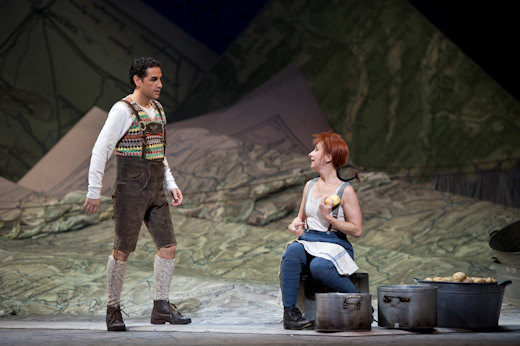
I hate new productions that have hideous looking costumes. And I'm not just expressing a personal preference. I have seen costumes that just looked awful. Dmitri Hvorostovsky did a music video of a song called "Toi et Moi" by contemporary composer Igor Krutoy. The music was good, but Dima's costume made him look like a fangirl version of a Death Eater. And it looked like just an excuse for him to be shirtless. What's with that? I have also heard of productions that did not fit the story at all. There was a guy in Germany who tried making Mozart's lighthearted romantic comedy The Abduction fro the Seraglio into a blood, guts, and sex squickfest. That doesn't fit at all. And I have also seen sets that are not very creative. I can't name any right off the top of my head right now, but I've seen them.
I'm writing this because the Metropolitan Opera just announced what will be shown next season, and I want to know that the new productions actually work.
Friday, January 4, 2013
The Joke Wasn't Funny The First Time
Legolas. Thranduilion. Is. Not. A. Girly. Elf.
I don't care if his hair looks hardly out of place after a battle. Nor do I care how feminine he looks. He is not girly.
I really don't like all these jokes about Legolas using shampoo (it does not exist in Arda). I have also heard jokes about him cross-dressing (which I never found funny). And these jokes about him being vain and talking about how he's the prettiest? To Utumno with that kind of joking! It was not funny the first time and frankly, they are not funny now. Why can't people just stop making these dumb jokes about Legolas being effeminate? They're not funny.
Sunday, July 8, 2012
Thoughts on Diversity
So the church I was worried about turned out to be run by someone who is godly and competent, and apparently qualifies to take on the job of running a church multicultural center. This is a good thing.
The only reason I initially freaked out is because I have had some rather bad experiences with the current ideas about what is often called "diversity". I'll agree that treating someone solely of the basis of race, sex, age, etc., is a bad idea, but the way it's being taught in this culture leaves a lot to be desired.
Let's start with this fact: No two people are alike. You've got men and women, each with their own personality and looks. People may have a similar body pattern (I've observed this), but no one has the same personality or looks.
With that in mind, let's look at how the issue of diversity is handled in our culture today.
Kids are taught from an early age to accept other people regardless of any differences. This is all good and well. However, as the kids grow up and move on from preschool and kindergarten to grade school on up, the tune slowly changes from "Accept other people despite their differences" to "White person-Bad, Minority person-Good".
We have all read about the troubles minority groups have faced in the past (slavery, discrimination, lynching, etc.). It used to be that white supremacy was one of the chief vices plaguing our country. Nowadays, you can't even say something bad about a black person without being labeled a racist.
Personal Experience: I had a very incompetent teacher for sophomore English. She deduced that the theme connecting all the stories we were reading was intolerance. I was already aware of the stupidities of "tolerance" as it is taught today. In this particular English class, I got the full force of it (I'm still mad at my teacher for that). She gave us a packet on The Laramie Project. Apparently, in 1991 two guys murdered a homosexual man in Wyoming. This sparked quite a bit of debate. People were shouting "Oh, he was killed for being homosexual; oh it was a hate crime, blah, blah, blah." This packet clearly left a lot to be desired. It was riddled with inaccuracies about prejudice, about Fred Phelps, the man who ran around carrying stupid signs about the murder victim in Hell, and was had more biases than the average politician (exaggerated for effect). I found out later on that the victim's murderers were thugs in the first place and at the time were high on meth. So that was not so much a "hate crime" and more of an ordinary mugging; the victim just happened to be a homosexual.
The teacher gave us a project on "tolerance" and had us go to this website on the subject. My dad looked over this website and found that there were more inaccuracies and lies on that website alone than I have ever come across in my twenty-one years; rivaled only by the incredibly stupid and inaccurate piece of junk known as my Sociology textbook from last summer. For example, one of the things the website suggested to become more tolerant of others was to "Increase my circle of friends". Whoever made this site clearly doesn't understand that most people don't make friends for a little more "diversity" in their portfolio. And most people have at least only one or two close friends. They may have a group of friends, but will only have a close bond with one of them. Therefore, "Increase my circle of friends" is not very sound advice. And making friends with someone who's black just because he's black is not a good way to go about this. In fact, it's reverse racism.
Another thing this lame excuse of a website suggested was to "Create a tolerance website". My dad said that doing so would be preaching to the choir. His reason was simple: "Are those idle thrill-seeker going to visit your website?" No one goes online to look for advice on how to become more "tolerant". They go online to spend hours playing RPGs and watch silly videos. They're not going to be interested in reading about "tolerance" at all.
How does one handle diversity? It's hard. Almost two centuries of prejudice have left many people, black, white, etc., with feelings of resentment. Everyone resents someone. And to get past this requires work. And to get rid of it is rough. What is really more important is who the person is, not what the person is. And no, being more "tolerant" does NOT mean condoning sin. All I can say is the best way to handle it is to love that person as yourself, even when their behavior offends you. Tell them that you love and respect them, but that you don't approve of immoral or improper behavior. And do it in such a way as to bring glory to God's name.
Sunday, July 1, 2012
What Is The Purpose?
The Wisconsin State Journal ran an article last Sunday about a church on the South Side of Madison which is building a cultural center. The idea is to bring people of other ethnic groups into the church and feel welcome.
At first glance this sounds like a good idea. However, as articles in the State Journal are notorious for leaving things out, it is not entirely clear to me what the purpose is in building this place and bringing in people from other ethnic groups. They said that one of the missions was to "be a gathering place where we can learn about each other's cultures. Fair enough.
But it doesn't say anything about reaching out to people and telling them the Good News of Jesus Christ. That might be the purpose, but there's no real indication that it is.
The other possibility (and the one I unfortunately suspect to be the most likely), is that this church just wants to make their congregation more diverse. They spoke of being a "neighborhood gathering place to bring various cultures together." That alone is not enough reason to build a cultural center.
If the purpose of this place is to reach out to other ethnic groups in order to bring more people into the Family of God, by all means; build this cultural center. Let people come and worship together and enjoy one another in Fellowship. Let us meet with fellow brothers and sisters in Jesus and share God's love with other people. The body of Christ is made up of people from every tribe, tongue, and nation the Bible tells us. But if the purpose is to bring other cultures together for the sake of bringing other cultures together, forget it. Don't build a cultural center. If it is not specifically for reaching out to other people, then there is no point in building one of these places. It's a church cultural center. So what? It's just a church cultural center. That doesn't mean anything to a Christ Follower unless it has the purpose of bringing people to Christ.
I'll agree with the pastor that there is a real problem with segregation. It has always been an issue since our country was being formed. But the purpose must be for the good of God's people instead of being just a cultural center that's part of a church. And as followers of Christ, we don't want the latter.
----------------------------------------------------------------------------------------------------------------------------
UPDATE: It turns out that the church in question is one that my church is partnered with and the pastor is a very Godly man. So this doesn't sound like a bad idea after all. It turns out that the pastor has been working hard in that community, and that if anyone is qualified for the job, he is. We should still pray for this operation, and ask God to let it work the way He wants it to, so that it doesn't become like I often think it will.
Saturday, June 16, 2012
Buzzwords That Should Stop Being Used
I have heard some really ridiculous sounding words and phrases that really should fall out of usage. These are words and phrases that don't have real meaning. They are meant to abuse and opponent or to make something sound good. Here are the ones that I find the most appalling:
Modern Woman
I remember reading a review of the '09 Disney film The Princess and the Frog. The heroine was described as a "modern woman".
I'll admit that there were all sorts of myths about happiness coming from a handsome prince and whatnot floating around back in the Victorian era. These myths would not have been so popular, however, if the marriage customs had been different. People married for more for money than for love back then, and they married whoever Mom and Dad picked out for them. So you were lucky if the person your parents selected actually cared about you.
But just because a woman knows that happiness comes from hard work and good character does not make her a "modern woman". King Solomon wrote of such a woman in his Proverbs: The Wife of Noble Character. This is the ideal woman. She puts her family before her and works hard to take care of them. This is nothing new. Why should it be considered a "modern" thing? It isn't. And when you think about it, "modern woman" doesn't really mean anything. Therefore, it should not be used.
Homophobic
A popular term of abuse among a lot people today. It's supposed to mean someone who hates homosexuals. It sounds more like "same fear", however, and that doesn't make a whole lot of sense. What's more, by saying that the person who disagrees with you has a irrational fear of you, you're being abusive to them. God says that homosexuality is wrong. Does that mean He God has a irrational fear of homosexuals? No, it does not. Therefore "homophobic" should fall out of usage because it is a term of abuse.
Bashing
This is supposed to mean insulting people of one particular group, but it's really a synonym for breaking or smashing. As a word for insulting, "bashing" should not be used.
There are plenty more buzzwords that I hate, but I can't think of them right now.
Modern Woman
I remember reading a review of the '09 Disney film The Princess and the Frog. The heroine was described as a "modern woman".
"She knows that happiness does not come from a handsome prince or a fairy godmother, but through hard work and good character"
(That's not the exact quote, but that is the basic gist.)
But just because a woman knows that happiness comes from hard work and good character does not make her a "modern woman". King Solomon wrote of such a woman in his Proverbs: The Wife of Noble Character. This is the ideal woman. She puts her family before her and works hard to take care of them. This is nothing new. Why should it be considered a "modern" thing? It isn't. And when you think about it, "modern woman" doesn't really mean anything. Therefore, it should not be used.
Homophobic
A popular term of abuse among a lot people today. It's supposed to mean someone who hates homosexuals. It sounds more like "same fear", however, and that doesn't make a whole lot of sense. What's more, by saying that the person who disagrees with you has a irrational fear of you, you're being abusive to them. God says that homosexuality is wrong. Does that mean He God has a irrational fear of homosexuals? No, it does not. Therefore "homophobic" should fall out of usage because it is a term of abuse.
Bashing
This is supposed to mean insulting people of one particular group, but it's really a synonym for breaking or smashing. As a word for insulting, "bashing" should not be used.
There are plenty more buzzwords that I hate, but I can't think of them right now.
Friday, May 11, 2012
Fanboy City
The LEGO company recently released an Oola minifigure for the latest release of another Jabba's Palace set. Just by looking at the design on the minifigure itself, I think there's no question as to how the fanboys are going to react. I'll admit I'm being rather general here (Most fans are not drooling squealers), but given what I've seen online regarding the dancing girl, I'm pretty sure it's the case with many people.

Wednesday, May 9, 2012
Don't Ban School Bake Sales
The PJ Tatler spoke about one of the most incredibly stupid bans I've heard about in my twenty-one years. The folks in charge of the education system in Massachusetts have passed a law that bans bake sales in schools claiming that selling cakes is contributing to the obesity crisis.
This is incredibly ridiculous and asinine for several reasons.
Reason Number 1: There is no evidence that these bake sales are in fact causing people to become fat. I've noticed that the portion sizes at these bake sales are usually very small. This is because they are sold by the slice so as to make a bigger profit, because the average person wants to by a small piece of Dobos Torte that costs only about two bucks as opposed to a full size torte that costs around twenty dollars or more.
I have frequently gotten pastries from the bakery in the Madison College building. Whenever I got a cake slice or a tart, I shared it with my family. And the money from the pastries sold helps keep the Madison College Baking Program going. I have also gone to bake sales (not very many though; they're often not going on where I am). I have gotten mostly small things, however, because that's what I can afford. And bake sales raise money for rent, field trips, and other things that a class, church, or school might need (it also gives people an opportunity to make something they love and share it with other people).
Reason Number 2: Banning a food item just because "it contributes to obesity" is ham-handed and has a tendency to backfire. You only make things worse by saying "This food is forbidden". When you send that message, the forbidden aspect makes it all the more desirable, and contributes even further to the problem of obesity. Besides, it's okay to have a piece of cake once in a while (I eat cake whenever I can get it, which is not as often as it might seem). And being ham-handed is more likely to turn people off to your point (believe me, I know this from personal experience). If you want to curb obesity, this is not the way to go.
Finally, it's the schools' own business what they do to raise money for field trips and whatnot. Unless the schools are doing something obviously illegal (which is almost never the case in my experience), the state should keep their abnormally large noses out of it. Bake sales have never done anyone any harm, so why should it even be an issue?
Are the folks in the government so hell-bent on lowering obesity rates that they want to exterminate anything that sounds like "junk food"? I'll agree that Americans do eat too much junk food, but outright bans are the wrong way to go about fixing the problem. And bake sales do bring in much-needed cash for schools to help further their students' education.
My personal experiences: My high school choir class did pizza sales once a years in order to raise money for field trips. My class actually assembled the pizzas in the school cafeteria, so that also taught us how to work together and get a job done; not to mention it also helped us build work skills. The Asian Club would sometimes sell spring rolls in the cafeteria after school and the Latin Culture Club would sell churros. And all were fund-raisers to help further students' education. \
So to the politicians in Massachusetts I say this: Get rid of this ban right now. There is no real evidence to prove that these bake sales contribute to the obesity crisis and it is foolish to even say so. Pastries are big money spinners, so why shouldn't people be allowed to make them and sell them? Seriously, please don't make baked goods into forbidden foods. It only makes them more desirable and contributes even more to the obesity problem.
Now if you all will excuse me, I think I hear a slice of Dobos Torte calling my name.
Sunday, April 29, 2012
A Clarification (No. 2): M. Pelly, Please Don't Compare Apples to Oranges to Paella
I would like to clarify something I ranted about in the previous entry. Laurent Pelly claimed that during Massenet's time, there was a fascination with dangerous women in literature. Pelly Updated Manon to that time period--the 1880's--with this idea in mind. However, he claimed that Manon had parallels with Violetta in La Traviata, and Carmen, whom he claims have this in common: That they were "great heroines who break the rules of their bourgeois society and are sacrificed to a hostile male world". There is one major problem with this assertion.
What we are talking about are three completely different women here. Manon is not a dangerous woman per say. Rather, she is a foolish and impulsive teenage girl who wants to have it all (who doesn't?). The only reason why she is labeled a loose woman is simply because of her fecklessness. When she and des Grieux live together again, she is trying to have both the love of des Grieux and the luxurious life. It is Manon's greed that drives her to become manipulative. She truly does love des Grieux, but her desire for the high life causes problems and is eventually what lands both her and des Grieux in serious trouble. So it isn't Manon being a dangerous woman in a male-dominated culture that causes her downfall. Instead, it is her being feckless, impulsive, and avaricious that leads to her and her lover's ruin.
Violetta is a courtesan, which is a high-priced prostitute. She too is truly in love with Alfredo, even though she is told to break it off. M. Germont does use a rather ham-handed method when telling Violetta to leave. At the same time, do remember that M. Germont is not concerned over nothing. When someone dates a person with a bad reputation, it affects the reputation of his family in a negative way. And despite her best efforts and her love for Alfredo, Violetta cannot get around her past (the fact that she is dying of tuberculosis only makes the matter worse). So, Violetta is not a victim of a male-dominated culture so much as a victim of her own bad reputation. That and TB.
Now, Carmen is a dangerous woman, but the fact here is that she knows she's bad news and makes no apologies for it. Unlike Manon and Violetta, Carmen is a poor gypsy girl and never stays in one place for long . She is a smuggler, a criminal. And when it comes to love, she prefers a brief relationship that only lasts six months. So she is never truly in love with Don Jose so much as infatuated with him for the nonce. And she has never seduced men like Don Jose before; men who have never been outside their hometowns and only know honest women like Micaela. It doesn't occur to Carmen in 65 million years that someone would actually want to marry her and spend the rest of his life with her. When she leaves Don Jose after a brief dalliance, she can't understand why he would demand that she come back to him. And when Don Jose finally kills her, he does it out of jealousy (which is not unheard of). So Carmen is a victim of jealousy rather than a male-dominated culture.
So what he have here are a foolish woman who truly is in love but her greed gets the better of her, a woman who is also truly in love but is a victim of her own bad reputation despite her best efforts, and a woman who is real dangerous woman who knows it and is a victim of a jealous ex-boyfriend. Neither of these women are victims of male-cultures per say. Manon is ruined by her own folly. Violetta is dying of TB and cannot escape her reputation as courtesan. And Carmen has never encountered a man like Don Jose in her life and falls victim to jealousy that is totally alien to her. Do any of these scream "sexist culture"? No. Two of these women are truly in love; unfortunately, one is a fool and the other has a bad rep. The other is a vamp and knows it; she just happens to seduce the wrong man.
Oh, and in regards to a bourgeois society., Violetta and Manon's world, France, is indeed bourgeois, but the women's sins are nothing new. Being a prostitute has always hurt a woman's reputation. And being foolish has also always been a big problem for someone. Carmen's world, Spain, is not bourgeois at all. Spain had been stuck in the Middle Ages for centuries and did not get a middle class until more than a hundred years ago. To say that Carmen "violates the rules of a bourgeois society" tells me the M. Pelly was not paying attention in history class when he was in school.
Manon is a fool, Violetta is a woman with a bad reputation, and Carmen is a vamp. Neither of them have anything really in common, so don't bother trying to assert that they do. They don't.
Enough said, so there.
Friday, December 23, 2011
Bar Signs
I was driving down Main Street while on my way to work, and there was a sign on the side of one of the bars reading, "There Is No Town Drunk. We Take Turns."
It's amazing what signs people come up with these days. Frankly, I think this goes on the list of most incredibly ridiculous. Taking turns at being the town drunk. What are these people doing? Being goofy or trying out for the role of Bob Ewell?
It's amazing what signs people come up with these days. Frankly, I think this goes on the list of most incredibly ridiculous. Taking turns at being the town drunk. What are these people doing? Being goofy or trying out for the role of Bob Ewell?
Subscribe to:
Posts (Atom)